
Video streaming has become the backbone of modern digital life — from entertainment and gaming to education and enterprise collaboration. But behind the convenience of seamless video playback lies a hidden challenge: energy consumption.
As demand for 4K, HDR, and immersive experiences grows, so does the computing power required to encode, deliver, and decode these streams. The result? Higher costs for providers and a larger carbon footprint for the planet.
At RudraStream, we believe the future of streaming must strike a careful balance: exceptional user Quality of Experience (QoE), technical performance at scale, and sustainability through green computing.
⚡ Why Energy Efficiency Matters in Streaming
- Cost savings: Energy-efficient codecs reduce server load, storage, and delivery costs.
- Device impact: Lower decoding complexity means longer battery life for end-user devices.
- Sustainability goals: Streaming already accounts for a significant portion of internet traffic. Optimizing energy usage aligns with global ESG commitments.
With billions of hours of video consumed daily, even a small efficiency gain per stream can translate into massive network-wide energy savings.
📊 What the Data Reveals
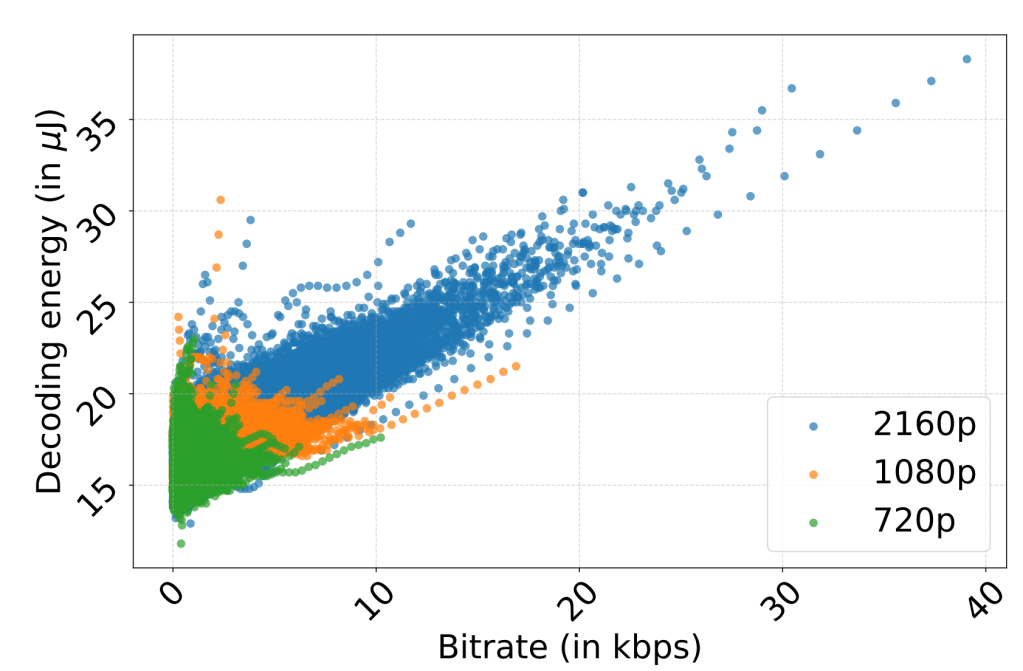
We analyzed AV1 encodes across resolutions (720p, 1080p, 2160p) and looked at how quality (VMAF) and decoding energy scale with bitrate.
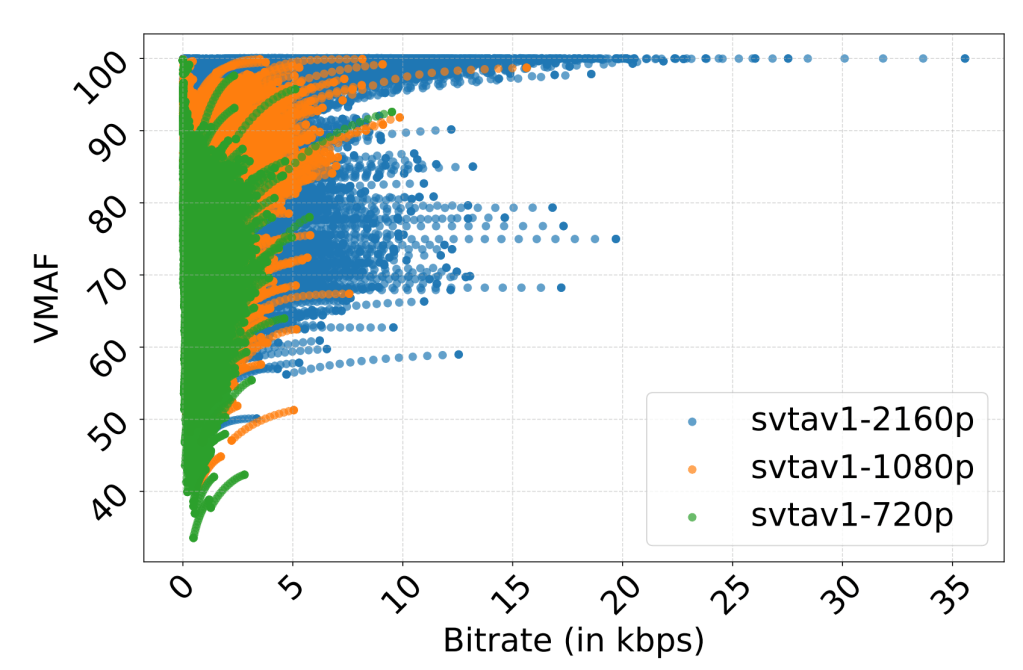
1️⃣ Bitrate vs. Quality (VMAF)
- Resolution matters: As we move from 720p → 1080p → 2160p, VMAF values rise at the same bitrate. In other words, higher resolutions deliver higher perceptual quality for the same data rate.
- Quality scaling: 720p saturates in quality (VMAF ~90), while 1080p and 2160p continue to climb higher, pushing into the ultra-high quality range (95+).
- Key insight: Investing bitrate at higher resolutions pays off with better perceptual quality — an important factor in UHD and premium streaming experiences.
2️⃣ Bitrate vs. Decoding Energy
- Energy rises with resolution: Decoding energy increases not just with bitrate, but also with resolution. At 2160p, devices consume significantly more energy compared to 1080p or 720p for the same data rate.
- Linear trend: The relationship between bitrate and decoding energy is roughly linear — more bits → more compute → more energy.
- Trade-off: While 4K streams deliver stunning quality, they also come with a heavier energy burden on playback devices, affecting battery life and sustainability targets.
RudraStream’s Perspective
The message is clear:
- Higher resolutions improve perceptual quality at a given bitrate.
- But energy costs scale up sharply, especially for UHD/4K.
- The future of adaptive streaming requires balancing these two axes — quality gains vs. energy costs — when building bitrate ladders and ABR strategies.
This is why RudraStream emphasizes energy-aware per-title encoding: we select not just the bitrate ladder, but also the resolution ladder that gives the best QoE-to-energy ratio for each piece of content.
Closing Note
As streaming grows, quality-per-bit and energy-per-bit must go hand-in-hand. Delivering 4K at all costs is not always optimal — the smarter future is resolution-aware, energy-efficient streaming.
 rudrastream.com
Leave a comment